
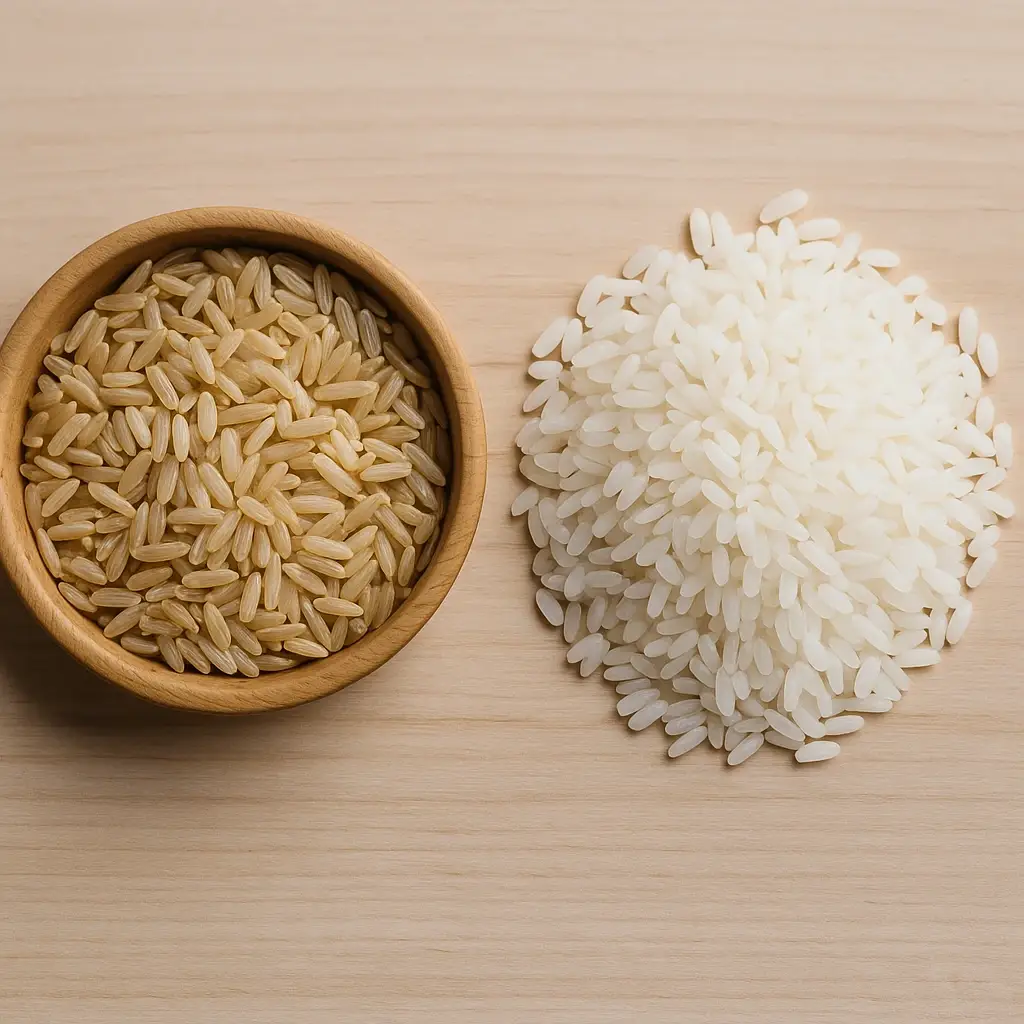
I used to believe the same thing you probably do—that brown rice was healthier than white rice. I thought I had to choke down boring, dry brown rice and give up sushi. I even went to Whole Foods and ordered brown rice sushi, thinking it was the healthier option.
This is all nonsense. White rice is far superior in every scenario, and eating large quantities of brown rice can even be dangerous. Let me bust these myths for you.
Myth 1: Brown rice has a lower glycemic index
The glycemic index measures how much your blood sugar rises after consuming a specific quantity of food. Brown rice does have a lower glycemic index because its bran and germ layers contain fiber, which slows digestion and leads to a less sharp rise in blood sugar.
However, you never eat rice by itself. You consume it with protein sources or vegetables, which act the same way as the bran in brown rice by slowing digestion. In reality, it makes no difference whether you eat brown rice or white rice when it comes to blood sugar control.
Myth 2: Brown rice contains more vitamins than white rice
This is true—brown rice contains higher levels of vitamin B, folate, and choline in its germ layer. However, this same germ and bran layer contains anti-nutrients, particularly phytic acid, which prevents the absorption of iron, zinc, and magnesium.
It’s much better to get your B vitamins and choline from more bioavailable sources like red meat and eggs, which have much higher levels without the anti-nutrients. These anti-nutrients can cause significant gut irritation, particularly when brown rice is eaten in large quantities. This is especially problematic for athletes who need substantial amounts of carbohydrates.
Myth 3: Brown rice is safer than white rice
Brown rice contains high levels of arsenic, which is classified as a Group 1 carcinogen by the International Agency for Research on Cancer. Rice accumulates around ten times as much arsenic as other cereals, and in rice grains, arsenic concentrates in the outer bran layer surrounding the endosperm. This means brown rice contains significantly more arsenic than white rice.
The Bottom Line
White rice is superior to brown rice because it’s an easily digestible form of carbohydrates and is particularly beneficial for athletes who need to consume high volumes of carbs. There are better foods to obtain your vitamins and minerals from—sources that are more bioavailable and don’t contain anti-nutrients that prevent mineral absorption.